
How ChatGPT Chooses Which Businesses to Recommend
We ran live local prompts and analyzed 30 citations. Here are the signals that decide which businesses ChatGPT names.

The short answer
ChatGPT doesn't keep a ranked list of businesses. When someone asks for a local recommendation, it rewrites the question into several web searches, reads what comes back, and names the businesses that independent sources agree on. In our tests those sources were mostly third-party "best of" lists, directories and review platforms, not the businesses' own websites. The business cards with star ratings come from licensed listing data, which since July 2026 includes Yelp.
So ChatGPT business recommendations reflect what the open web says about you, not only what your own site says. They're also unstable. We asked ChatGPT the same question three times in a row and got three different top picks.
To show how ChatGPT chooses which businesses to recommend, below is what we saw in live prompts, what our clients' tracking data shows, and what local service businesses can do about it.
How ChatGPT actually finds businesses
There are two information layers behind every answer.
The training data layer. This is what the model learned before its cutoff. It knows that plumbers fix leaks and that Houston is in Texas. It doesn't reliably know which locksmith on your street is open tonight, so for local questions ChatGPT almost always goes to the web.
The live search layer. OpenAI's help center says ChatGPT search rewrites your question into one or more targeted queries and sends them to third-party search providers, and that it can use your approximate location (from your IP address) for local results. OpenAI doesn't name all its providers or explain how sources are ranked. Its crawler documentation adds one practical rule: a site that blocks OAI-SearchBot won't be shown in ChatGPT search answers.
We could watch this happen. Rankability, the tracking platform we use, captures ChatGPT's search activity for some prompts. For "Who are the best kitchen remodeling contractors in Poway, CA?" ChatGPT ran 7 different searches, including one restricted to the California license board's site. It pulled back 55 pages. It cited 5 of them.
That ratio is the real game. Getting retrieved is easy. Getting cited and named is the hard part.
Licensed business data. On top of web search, ChatGPT shows structured business cards with ratings, review counts, phone numbers and a map. In July 2026, Axios reported that Yelp is licensing its reviews, ratings, photos and business details to OpenAI. A Steady Demand study from August 2026 (4,607 runs) found Yelp attached to 95.83% of those business cards. The same study found Foursquare at 0.00%, which debunks the popular claim that most ChatGPT local results come from Foursquare. For restaurants, TripAdvisor, OpenTable and Resy also appear. In our own tests, ChatGPT sometimes labeled ratings as Google reviews, so Google data shows up too.
So a recommendation from what it reads has three inputs: what the model already knows, what it finds in a live search, and what licensed listing providers say about the business. The recommendation layer on top weighs them against the user's question.
Our test: same question, three different winners
On November 16, 2026, we asked ChatGPT four local questions in fresh temporary chats (no memory, no history), signed in, from the same computer:
"Who is the best emergency locksmith in Houston, TX?" (asked three times)
"Recommend a reliable ADU builder in Los Angeles"
"What's the best long-distance moving company in New York City?"
"Which HVAC company in Phoenix should I call for an AC repair?"
Every answer opened with a confident first pick, then showed business cards with a rating, review count, phone number and map. Here is what the three identical locksmith questions returned:
| Run | Top pick | Also named |
|---|---|---|
| 1 | 24/7 Mobile Locksmith | CJS Locksmith, Airborne Locksmith, 24 Hour Locksmith Service LLC |
| 2 | CJS Locksmith | Airborne Locksmith, Howard Safe & Lock |
| 3 | Airborne Locksmith | CJS Locksmith, Pop-A-Lock of Houston |
Three runs, three different top picks. Only two businesses, CJS and Airborne, appeared every time. Pop-A-Lock showed up in run 3 because ChatGPT found it ranked first in a November 2026 Houston locksmith comparison list, which it cited.
Larger studies see the same instability. Steady Demand ran 1,487 local queries across 50 U.S. metros and found that asking Gemini the same question twice gave overlapping sources only about 40% of the time, and that Gemini and ChatGPT recommended the same top business just 4.2% of the time. Its advice, which we agree with: treat one AI answer as a snapshot, not a ranking.
The top pick that wasn't from Houston. In run 1 we clicked the top pick to see ChatGPT's details panel. It described "24/7 Mobile Locksmith Union Square NYC," a dispatch service that connects callers with nearby providers. Its sources were that company's website and a Better Business Bureau profile in Scottsdale, Arizona. The van in the photo shows a Florida (941) area code. ChatGPT appears to have merged several businesses with the same generic name into one recommendation for Houston.
Figure 1
The Houston top pick was a New York dispatch service
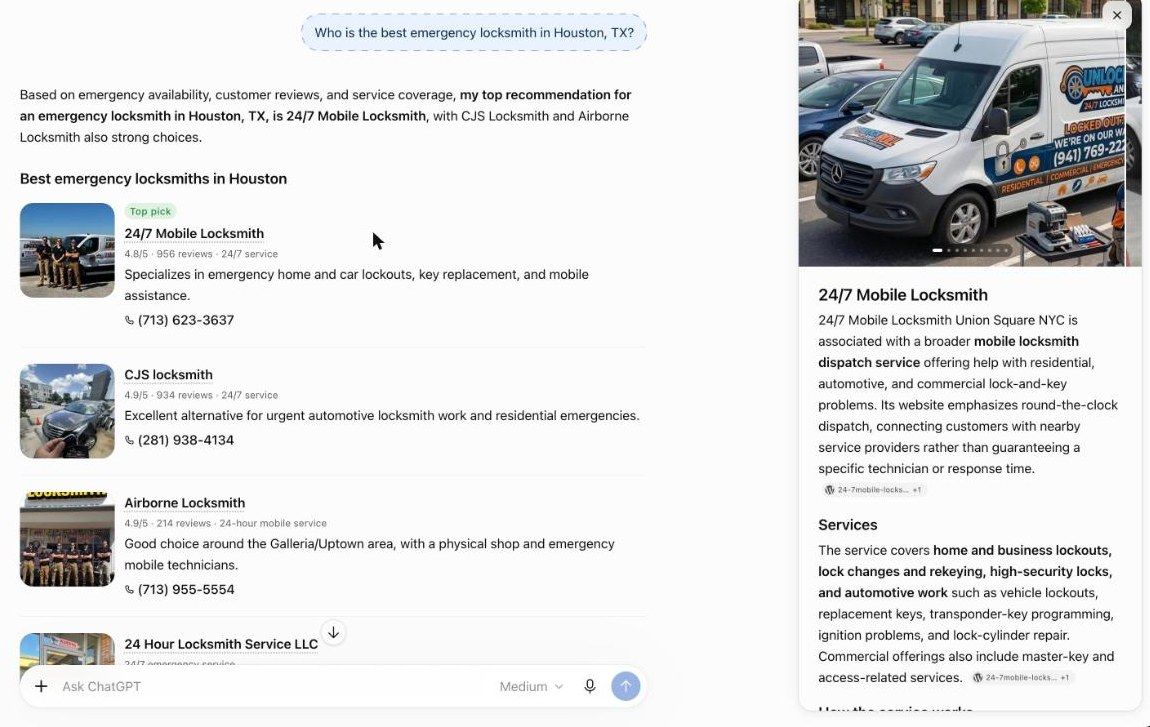
That's not a reason to distrust every answer. It's a lesson about entities: when your business name is generic and your facts aren't consistent across the web, ChatGPT can confuse you with someone else, or someone else with you.
What the other answers cited. The ADU answer backed up its picks with an independent contractor directory. The moving answer cited ConsumerAffairs' ranking and moveBuddha's review totals. The Phoenix HVAC answer cited two third-party contractor sites, 5 Star Home Service Pros and ContractorsRanked, and quoted Google review counts. In every answer, the visible citations pointed to third-party sites, not to the recommended companies' own pages.
The signals that decide who gets named
OpenAI hasn't published how it ranks businesses. But the answers explain their own reasoning, and the patterns repeat. ChatGPT is looking for a business that is relevant, nearby, and well reviewed, and it wants more than one source to say so.
1. Relevance to user intent. The question decides the shortlist. "Emergency locksmith" pulled businesses that advertise 24/7 service. "Full system replacement" pulled HVAC companies that describe complete changeouts, not just repairs. If your pages don't state the exact customer problem you solve, ChatGPT has nothing to match.
2. Location and service area. Every answer listed addresses, neighborhoods or a map. A business with a clear street address, city and service area in plain text is easy to place. A business with a vague "serving all of Southern California" isn't.
3. Reviews and review volume. Ratings and review counts appear on nearly every card. But volume isn't everything: in the ADU answer, a builder with 17 reviews made the list next to one with 186. SOCi's 2026 Local Visibility Index, which covered more than 350,000 locations, found ChatGPT recommended only 1.2% of them, and the ones it did recommend averaged 4.3 stars.
4. Third-party sources and "best of" lists. This is the signal most businesses miss. When ChatGPT explains a pick, it usually points to someone else's page: a ConsumerAffairs ranking, an Angi list, a Houzz category, a local comparison article. Steady Demand found ChatGPT cited business websites only 15.9% of the time in local answers, versus 59.9% for Gemini.
5. Licensed listings. Yelp, Google Business Profile data, TripAdvisor, OpenTable and Resy feed the business cards. An incomplete or unclaimed profile means a weaker card, or no card.
6. Verifiable facts. ChatGPT checked contractor licenses on California's license board site in several answers, and repeated license numbers it found. Structured data, consistent business names and matching phone numbers make those facts easy to confirm. Inconsistent ones cause the kind of mix-up we saw with the Houston locksmith.
What it reads but rarely cites: Reddit. In the Poway kitchen search, 22 of the 55 pages ChatGPT retrieved were Reddit threads. None were cited. UK agency Whito reported that ChatGPT stopped leaning on Reddit for local answers in August 2026, though OpenAI says Reddit is still cited. Community discussions still shape what the model reads, so they're worth monitoring, but they aren't where your citations come from.
What our clients' tracking data shows
A single test is a snapshot, so we also looked at the prompts we track daily or weekly for our clients in Rankability. We took the six "best [service] in [city]" questions with a ChatGPT answer captured between November 11 and 16, 2026: general contractors, kitchen remodelers and retaining-wall contractors around San Diego, HVAC and window companies in San Diego, and locksmiths in Manhattan's West Village.
Those six answers cited 30 sources. Here is where they pointed:
| Source type | Citations | Examples |
|---|---|---|
| "Best of" ranking lists | 12 | ConsumerAffairs, Angi, HomeAdvisor, Expertise, ContractorsRanked |
| Directory profiles and records | 5 | BuildZoom, loc8nearme, permit-record sites |
| Government license lookups | 6 | California Contractors State License Board |
| Business websites | 7 | 6 of them in a single answer |
Third-party pages made up 17 of the 30 citations. Business websites made up 7, and six of those came from one answer about window companies that linked each company's homepage. In the other five answers, only one business got a link to its own site, and it was a dedicated retaining-wall service page.
The pattern held for our clients too. In the Poway general-contractor answer, our design-build client was named third, with its address, rating and 256 reviews, and the answer cited no sources at all except the license board. ChatGPT built that list from business listing data. The client's website didn't need to be cited for the client to be recommended.
The flip side shows up in analytics. When ChatGPT does send traffic, it goes to specific pages. As we showed in our post on free AI search tools, GA4 data for a Houston locksmith client showed ChatGPT sending 76 visits to individual car-brand key pages in four months, while all organic search engines combined sent 19. Being named depends on third-party agreement. Getting the click depends on having the page that answers the follow-up question.
What to do about it: a checklist for local businesses
In order of impact, based on what we've seen:
Get onto the "best of" lists ChatGPT already cites. Ask ChatGPT your top three customer questions, note the list pages it cites (ConsumerAffairs, Angi, Expertise, local comparison articles), and work to get included: claim profiles, request a review, or pitch the editor. This is the closest thing to a direct lever.
Claim and complete your Yelp and Google Business Profile listings. These feed the business cards. Use the same business name, address, phone and categories everywhere. NAP consistency is what prevents the Houston-style mix-up.
Keep reviews coming on more than one platform. Google, Yelp, Facebook, BBB and your industry's directory (Houzz, Angi, Trustpilot, TripAdvisor). ChatGPT quotes ratings and counts, and it reads the review text for specifics like "showed up in 30 minutes."
Write one page per service and city that answers the customer problem plainly. State the service, the area, the hours, the price range and your license number in text, not only in images. Add structured data (LocalBusiness and Service schema) so the facts are machine-readable.
Make your license and credentials easy to verify. ChatGPT checked state license boards on its own. Put your license number on your site so it matches what the board shows.
Earn mentions in local media and industry publications. A mention in a local news story or trade association directory is one more independent source that agrees you exist and do good work.
Don't block OAI-SearchBot. Check your robots.txt and your CDN or firewall settings. If it can't read your site, ChatGPT search can't show it.
Track a fixed set of prompts over time, not one answer. Answers change run to run, so you need repeated checks to see a trend. Record the prompt, date, businesses named and sources cited.
What won't work: paying for placement in the answer. ChatGPT now shows labeled ads below responses on its Free and Go plans, but OpenAI says ads don't influence ChatGPT's answers, and nobody can guarantee a recommendation. Anyone selling a guaranteed ChatGPT ranking is selling something they can't control.
FAQ
How does ChatGPT decide which businesses to recommend?
It searches the web for the question, reads third-party lists, directories and review platforms, pulls business details from licensed listing data such as Yelp, and names the businesses that several sources agree are relevant, nearby and well reviewed. OpenAI hasn't published the exact ranking method.
Can you pay ChatGPT to recommend your business?
No. OpenAI sells labeled ads that appear below some answers, but says ads don't influence the answers themselves. The practical path is improving the public information ChatGPT reads about you.
Does a Google Business Profile help with ChatGPT?
It helps, but it isn't enough on its own. In our tests ChatGPT sometimes quoted Google review counts, but Steady Demand's study found Yelp data attached to far more of its business cards. Keep both complete and consistent.
Why is my business on Google but not mentioned by ChatGPT?
Google ranks pages. ChatGPT looks for agreement across sources. A business can rank well on Google but be missing from the "best of" lists and directories ChatGPT cites, or have inconsistent details that make it hard to verify.
Why does ChatGPT give a different answer every time?
Each answer runs new searches and samples different sources. In our test, three identical questions returned three different top picks. Track a fixed set of prompts over time instead of trusting one answer.
How can I track whether ChatGPT mentions my business?
Write down 10 to 20 questions your customers actually ask, run them on a schedule, and record the date, the businesses named and the sources cited. A prompt-tracking tool automates this across ChatGPT, Gemini, Perplexity and Google's AI features. GA4's AI Assistant channel shows the visits that result.
Methodology
Live test. Four prompts, six runs in total, in ChatGPT on November 16, 2026, each run in a new temporary chat in a signed-in account, default model with the Medium thinking setting, from a US connection. The Houston locksmith prompt was asked three times. We recorded the businesses named, the top pick and every visible citation, and opened the details panel for one business. Collapsed citation chips ("+1", "+2") were not expanded, so citation counts from the live test are conservative.
Client tracking data. Six "best [service] in [city]" prompts tracked daily in Rankability for three Foundency clients, using the latest ChatGPT capture between November 11 and 16, 2026. We counted every citation in the six answers and classified each by source type. For the Poway kitchen prompt, Rankability captured ChatGPT's search queries and retrieved pages, which is where the 7 searches, 55 retrieved pages and 5 citations come from. Clients are anonymized.
Limits. This is a small sample, one country and one assistant. It shows patterns, not a ranking formula. Answers change over time and between users.
Sources
Searching the web with ChatGPT, OpenAI Help Center
Ads in ChatGPT, OpenAI Help Center
Exclusive: Yelp partners with ChatGPT to surface reviews, Axios, July 23, 2026
ChatGPT's Local Results Aren't Coming From Foursquare, Steady Demand, August 21, 2026
Business websites dominate Gemini local AI search citations: Study, Search Engine Land (Steady Demand's 1,487-query study)
Gemini local AI citations study, PinMeTo (ChatGPT business-website citation share)
Why AI Search Is Replacing Google for Local Business Discovery, IPS News (SOCi 2026 Local Visibility Index)
Who does AI cite for UK local recommendations, Whito, August 2026