
Five Content Gaps That Keep Brands Out of AI Answers
Five content gaps that keep brands out of AI answers, with real ChatGPT data: missing questions, third-party lists, inconsistent facts, weak proof and unreadable pages.

The short answer
Most brands that are missing from AI-generated answers aren't missing because of their Google rankings. They're missing because of content gaps that keep brands out of AI answers: things AI assistants look for and can't find. From our clients' tracking data and our own tests in November 2026, five gaps come up again and again:
The question gap. Your site answers broad topics, but customers ask AI long, specific questions.
The third-party gap. AI cites "best of" lists, directories and reviews, and you're not on them, or not on enough of them.
The consistency gap. Your name, address, services or facts differ across the web, so AI can't tell which business is you.
The proof gap. Your pages make claims ("top-rated," "experienced") without the specific facts AI repeats: license numbers, years in business, review counts, prices.
The retrievability gap. Your content is there for people but not for AI crawlers, because it loads with JavaScript, sits in images or PDFs, or the crawler is blocked.
Each one is fixable, and each section below shows what it looked like in real data and how to close it.
Why content gaps matter more in AI search
A Google results page shows ten links, ads and a map. If you're number seven, someone may still click. An AI answer shows three to eight names and a first pick. If you're not on that shortlist, you're invisible for that question.
The shortlist is small, and the audience is growing. BrightLocal's 2026 Local Consumer Review Survey found 45% of US consumers had used an AI tool to find a local business, up from 6% a year earlier. SOCi's 2026 Local Visibility Index found ChatGPT recommended only 1.2% of the 350,000-plus business locations it studied.
The gap is also a different kind of gap. A classic SEO content gap analysis asks which keywords competitors rank for and you don't. An AI citation gap asks something else: when an assistant answers a question your customer asked, what did it need to read, and was any of it about you? In one prompt we tracked, ChatGPT ran 7 searches and retrieved 55 pages, then cited 5. Getting retrieved is common. Being cited and named takes content that matches the question, is backed by public evidence, and agrees with what other sources say.
That's why we audit these five gaps before writing anything new. Creating new content without a baseline usually adds more pages that AI still doesn't use.
Gap 1: The question gap
What it is. Your site covers the head topic ("car key replacement") but not the specific questions people type into an AI assistant ("who can replace a 2019 Lexus key in Houston tonight?"). People ask AI assistants longer, more detailed questions than they type into Google, and the assistant goes looking for a page that answers that exact information need.
What it looked like in real data. A Houston locksmith client has a separate page for each car brand it makes keys for. On Google, those pages sit on page 2 or 3 and get almost no clicks. ChatGPT links to them. Between July and November 2026, GA4 recorded 76 ChatGPT visits to those car-brand pages, against 19 from all organic search engines combined. Six of the brand pages got zero organic visits and 39 visits from ChatGPT.
The pages that won were the specific ones. A car brand without its own page can't win that visit, because there's no page for ChatGPT to send people to.
How to close it.
List the questions customers actually ask: sales calls, emails, reviews, "People also ask" boxes, and your own ChatGPT tests. Include the city, the model, the deadline, the budget.
Map each question to an existing page. Every question with no page, or only a passing mention, is a gap.
Build answerable pages, not thin FAQ piles. One page per service and location or per product and use case, with the direct answer in the first two sentences.
Don't mass-produce near-duplicates. Google's spam policies target scaled content abuse, and duplicate content gives AI nothing new to cite. Each page needs facts unique to that case.
Gap 2: The third-party gap
What it is. AI assistants rarely take a brand's word for it. They look for independent pages that agree: "best of" lists, directories, review platforms, industry publications. If your owned content is strong but third-party coverage is thin, you have a citation gap.
What it looked like in real data. Across six "best [service] in [city]" questions we track for clients, ChatGPT's answers cited 30 sources. Seventeen were third-party lists and directories. Seven were business websites, and six of those came from a single answer.
That single answer is worth a closer look. On November 16, 2026, ChatGPT answered "Who are the best window replacement companies in San Diego?" and cited four ranking lists: ConsumerAffairs, Expertise, Birdeye and TenBestFind. We checked who appears on each:
| Company | Lists it appears on (of 4) | Named by ChatGPT? |
|---|---|---|
| BM Windows | 3 | Yes, top pick |
| Sivan Windows and Doors | 2 | Yes |
| 360 Windows and Doors | 2 | Yes |
| Coughlin Windows & Doors | 2 | Yes |
| Newman Windows and Doors | 1 | Yes |
| American Vision Windows | 0 | Yes |
| Renewal by Andersen, Clear Concepts, US Window & Door | 3 each | No |
| Our client | 1 | No |
Two lessons. First, the lists are where ChatGPT goes to build its candidate pool, so being on more of them helps: the top pick was on three of four. Second, list presence isn't enough. Three companies on three lists each weren't named, and one company on none was. ChatGPT linked the homepage of every business it did name, so it was checking each candidate's own site and listing too. Our client sat on one list and wasn't named.
How to close it.
Run your top customer questions in ChatGPT, Perplexity and Google AI Mode, and write down every third-party page cited. That list is your outreach plan.
Get onto the lists that already rank: claim directory profiles, ask the publisher how companies are chosen, and earn the reviews they use.
Keep reviews coming on several platforms, not just Google.
Earn brand mentions in local news, trade associations and industry publications. Each one is another independent source that agrees with you.
Then make sure your own site backs up what the lists say (that's gaps 3 and 4).
Gap 3: The consistency gap
What it is. AI assistants have to decide which real-world business a page is about. When your business name, address, phone number, services or hours differ between your site, Google Business Profile, Yelp, BBB and directories, that decision gets harder. The result is either that you're left out, or that you're confused with someone else.
What it looked like in real data. We asked ChatGPT "Who is the best emergency locksmith in Houston, TX?" Its top pick was "24/7 Mobile Locksmith." When we opened the details panel, it described a dispatch service in Union Square, New York, cited a Better Business Bureau profile in Scottsdale, Arizona, and showed a van with a Florida area code. It appears to have merged several businesses with the same generic name into one recommendation for Houston.
Figure 1
The Houston top pick was a New York dispatch service
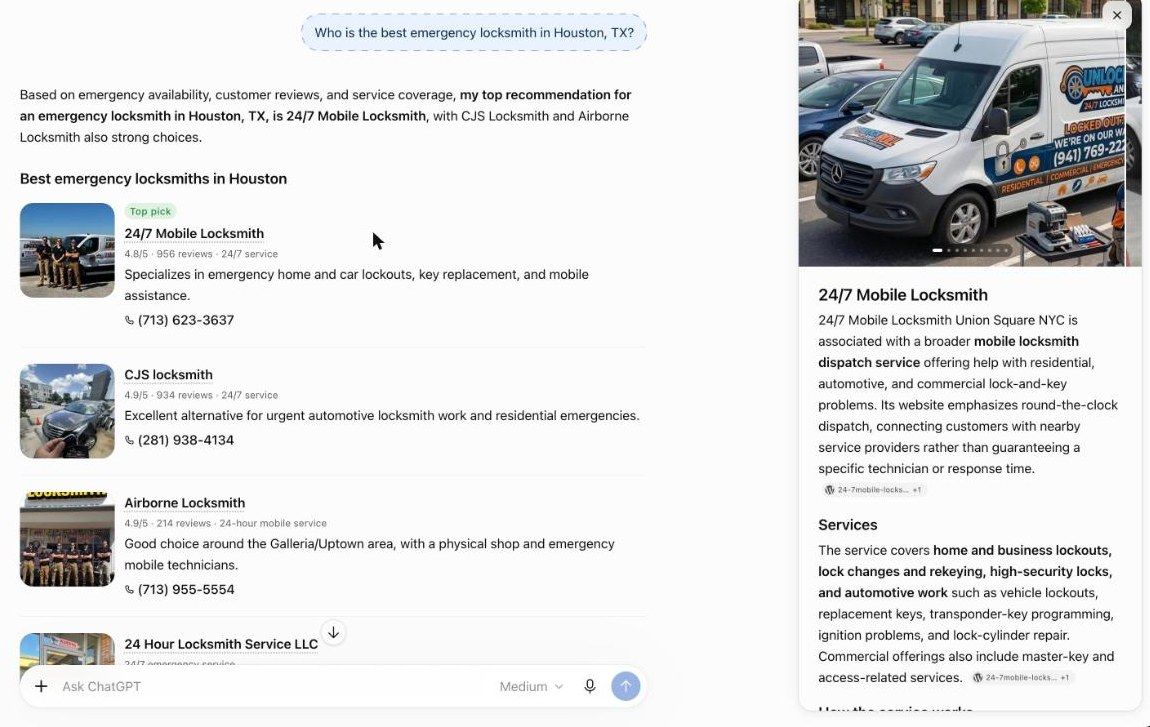
ChatGPT, November 16, 2026: a Houston recommendation whose details describe a business in New York.
That's a consistency gap working in reverse: a generic name with scattered facts let ChatGPT stitch together a business that doesn't exist in that form. If your brand name is common in your industry, the same thing can happen to you, and a competitor's reviews or complaints can end up attached to your name.
How to close it.
Audit the high-impact facts first: legal and trading name, address, service area, phone, hours, license number, core services, prices. Check them on your site, Google Business Profile, Yelp, Apple Maps, Bing Places, BBB and your top three industry directories.
Pick one canonical version of each fact and fix every mismatch. Close or merge duplicate listings.
Add Organization or LocalBusiness structured data with sameAs links to your official profiles, so machines can connect them.
Use a distinctive brand name everywhere, with the city when your name is generic ("Smith Locksmith of Houston").
Set an update discipline: when hours, prices or services change, change them everywhere the same week. Updated brand information on your own site alone isn't enough.
Gap 4: The proof gap
What it is. Most service pages are full of claims an AI can't use: "top-rated," "experienced team," "quality you can trust." AI summaries drop those words, because every competitor says the same thing. What survives AI summarization is concrete information: a license number, a founding year, a review count, a brand you install, a price range, a guarantee with terms.
What it looked like in real data. Read ChatGPT's answers closely and you can see exactly which facts it lifted from each business. From the San Diego and Poway answers we track:
"Established company, operating since 1977"
"Established company operating since 1993"
"California B–General Building license #781576 is listed as current and active"
"4.9/5 rating from 140 reviews" on Houzz
"Carries Milgard, Simonton and other brands"
"Emphasizes its own installation crews rather than subcontractors"
"Mitsubishi dealer"
Every one is a checkable fact. None is an adjective. Where ChatGPT found specifics, it used them. Where it didn't, the description fell back to a generic line, like "good alternative for lock repairs, key duplication, and emergency service" for one Manhattan locksmith.
The proof gap also costs you after the click. In our client data, Microsoft Clarity showed that visitors arriving from ChatGPT viewed 32% more pages per session than organic search visitors but scrolled less. They arrive with an answer already and are checking you out. Proof buried at the bottom of the page doesn't get seen.
How to close it.
Replace every adjective claim with the fact behind it. "Experienced" becomes something like "120 ADUs permitted in Los Angeles since 2016," using your real numbers.
Put your license number, years in business, review count and service area near the top of every service page.
Show the work: project photos with location and date, case studies with numbers, named brands and certifications.
Add demonstrated expertise: who did the work, their credentials, a short expert input on each page.
Link to the public evidence (license lookup, review profiles) so an AI, and a customer, can verify it.
Gap 5: The retrievability gap
What it is. The content exists, but AI can't read it. The usual causes are content that only appears after JavaScript runs, key facts inside images or PDFs, and AI crawlers blocked by robots.txt, a CDN or a firewall. Crawlable content is the entry ticket: nothing else on this list matters if the crawler gets an empty page.
What it looked like in real data. A crawl-log study by Vercel and MERJ found that none of the major AI crawlers execute JavaScript, including OpenAI's GPTBot and OAI-SearchBot and Anthropic's ClaudeBot. So in November 2026 we fetched 27 live homepages the way an AI crawler does, with no JavaScript, and compared the words it got with what a person sees:
| Platform | Share of the page an AI crawler could read (median) |
|---|---|
| Astro | 100% |
| Next.js | 100% |
| WordPress | 98% |
| Lovable | 83% |
| Shopify | 64.5% |
The worst case was a Lovable site that showed people 2,258 words and showed AI crawlers 11: a "Loading…" message. On Shopify stores, product grids, prices and review widgets loaded by apps were often missing. Our full test is in Which Website Platform Is Best for Winning in AI Search?
How to close it.
Check what a crawler sees. View your page source (not the inspector) or fetch the page with JavaScript off. If your services, prices and reviews aren't in the HTML, AI can't read them.
Make sure robots.txt and your CDN allow OAI-SearchBot, ChatGPT-User, PerplexityBot and ClaudeBot. OpenAI says sites that block OAI-SearchBot won't be shown in ChatGPT search answers.
Move key facts out of images and PDFs into page text. Price sheets, license certificates and service lists in images are invisible.
Write for clear summarization: a direct answer summary under each heading, short paragraphs, descriptive headings and tables for comparisons.
Add structured data for the facts that matter (LocalBusiness, Service, Product, FAQPage).
How to find your own gaps in an afternoon
You don't need a tool to start. You need a spreadsheet and three hours.
Step 1: Write 15 to 20 real customer questions (45 minutes). Mix them: "best [service] in [city]," comparisons ("[you] vs [competitor]"), specific needs ("who installs heat pumps in older homes in [city]"), and questions about you by name ("is [brand] licensed?"). These are the prompts that map to buyer decisions.
Step 2: Ask them in ChatGPT, Perplexity and Google AI Mode (90 minutes). Use a fresh or temporary chat each time. For each answer, record whether you're named, who is named, and every source cited. Ask your three most important questions twice, because answers change.
Step 3: Sort what you found into the five gaps (45 minutes).
| If you see this | It's probably this gap |
|---|---|
| You're never named for specific questions, and you have no page that answers them | Question gap |
| Competitors are named, and the cited sources are lists and directories you're not on | Third-party gap |
| AI gets your address, services or hours wrong, or mixes you up with another business | Consistency gap |
| You're named, but described in generic words, or a competitor gets the specifics | Proof gap |
| You have the right page, but AI never cites it | Retrievability gap (check it with JavaScript off) |
Step 4: Fix in this order. Retrievability first, because nothing else works until AI can read your pages. Then consistency, which is mostly cleanup. Then proof on your existing pages, then new pages for the question gap, then third-party outreach, which takes longest.
Step 5: Re-check monthly. Rerun the same prompts and compare. A one-time check tells you where you stand; repeated checks show whether your fixes worked. Prompt-tracking tools (sometimes called AI brand visibility software) automate this daily and calculate your AI share of voice against competitors. GA4's AI Assistant channel shows whether the visits and leads follow.
FAQ
What content gaps keep a brand out of AI answers?
The five we see most are the question gap (no page for the specific questions customers ask), the third-party gap (missing from the lists and directories AI cites), the consistency gap (conflicting business facts across the web), the proof gap (claims without checkable facts) and the retrievability gap (content AI crawlers can't read).
Why do strong Google rankings not guarantee AI visibility?
Google ranks individual pages. AI assistants build a short answer from several sources and favor businesses that independent sources agree on. In our data, ChatGPT sent visitors to a client's car-brand pages that rank on page 2 or 3 of Google, and left out businesses that appear on several ranking lists.
What is the difference between an SEO content gap and an AI citation gap?
An SEO content gap is a keyword competitors rank for and you don't. An AI citation gap is a question where an AI assistant names competitors and cites sources that don't mention you. Closing it often means work off your own site, such as directory profiles and reviews.
How can a brand fix content gaps that keep it out of AI answers?
Map real customer questions, check how AI answers them, sort what you find into the five gaps, and fix them in order: make pages readable to crawlers, align business facts everywhere, add concrete proof, build pages for missing questions, and earn third-party coverage.
How long does it take to show up in AI answers after fixing gaps?
It varies. Retrievability and consistency fixes can show up within weeks, once crawlers revisit and listings update. Third-party coverage takes longer. Because AI answers change from run to run, measure with a fixed prompt set over several weeks rather than a single check.
Methodology
Client tracking data. Six "best [service] in [city]" prompts tracked daily in Rankability for three Foundency clients (latest ChatGPT capture between November 11 and 16, 2026). We counted and classified every citation in the six answers. The search and retrieval counts come from Rankability's capture of ChatGPT's searches for one prompt. Clients are anonymized.
Window list check. For the San Diego window answer captured on November 16, 2026, we opened the four cited ranking pages the same day and recorded which companies each listed. Birdeye's page showed 10 of the 23 businesses it says it found; we counted only those shown.
Houston test. "Who is the best emergency locksmith in Houston, TX?" asked in a new ChatGPT temporary chat on November 16, 2026. We opened the top pick's details panel and recorded its sources.
Analytics. GA4 and Microsoft Clarity data from Foundency clients, July to November 2026, as described in our post on free AI search tools.
Crawler test. 27 live homepages tested on November 13, 2026, as described in our platform comparison post.
Sources
Local Consumer Review Survey 2026, BrightLocal
Why AI Search Is Replacing Google for Local Business Discovery, IPS News (SOCi 2026 Local Visibility Index)
The rise of the AI crawler, Vercel and MERJ
Searching the web with ChatGPT, OpenAI Help Center
Spam policies for Google web search, Google Search Central
Ranking pages checked: ConsumerAffairs, Expertise, Birdeye, TenBestFind